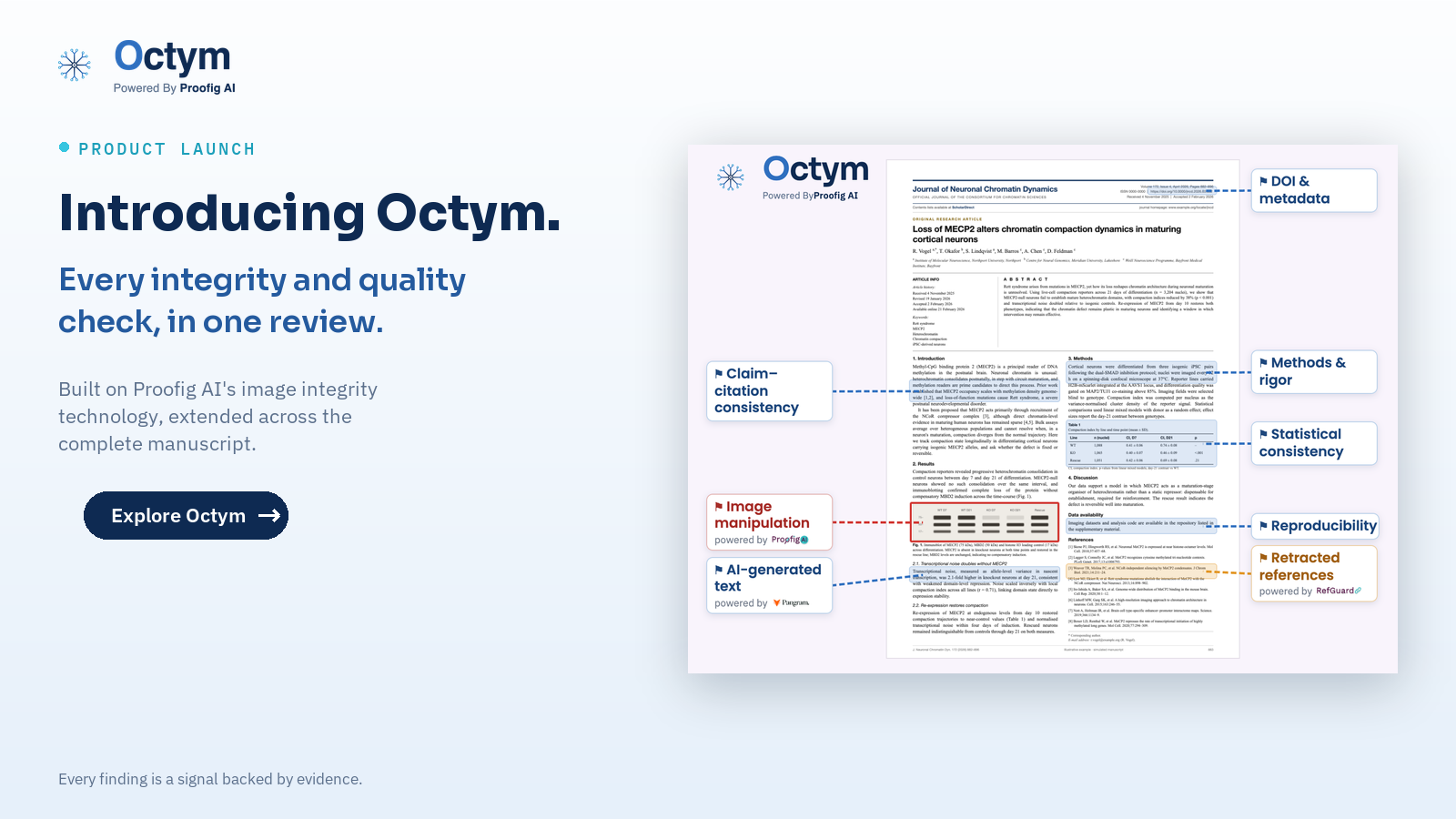


PubShield is an institutional manuscript quality assurance hub, a product distinct from Proofig AI, that consolidates multiple integrity checks into a single workflow. It brings together partner tools including Proofig AI’s image integrity screening, DataSeer’s data compliance checks, iThenticate’s text similarity analysis, Pangram’s AI-generated text detection, and RefGuard’s reference integrity checks. These are all PubShield partners, not standalone Proofig AI features. By consolidating these checks, PubShield gives institutions a more complete view of manuscript quality before publication, without requiring separate tools, logins, or manual coordination.
Why Do Fragmented Screening Workflows Create Blind Spots?
Most institutions and publishers that perform integrity checks at all run them in isolation. Image screening happens in one tool, text similarity in another, data reporting compliance in a third, and reference checking may not happen at all. Each tool has its own interface, its own login, and its own output format. The result is a fragmented process where no single person or dashboard has a complete picture of a manuscript’s integrity status.
This fragmentation is a structural problem, not a failure of individual researchers or editors. The scale of the challenge makes it clear why manual coordination falls short. According to data from UKRIO and image integrity specialists, roughly 20 to 35 percent of life-science manuscripts submitted to journals are flagged for image-related issues. Separately, a peer-reviewed analysis of top-20 world-class universities documented retraction patterns across 2010 to 2019, with image manipulation among the leading causes. And data reporting gaps, while less visible, represent a distinct compliance risk that compounds the problem.
When these checks are scattered across disconnected platforms, issues slip through. An institution might catch a text similarity problem but miss a duplicated figure, or flag an image concern but overlook incomplete data availability statements. The cost of these missed checks surfaces after publication, when corrections, retractions, and investigations become far more expensive and damaging.
What Does Proofig AI Contribute Inside PubShield?
Within PubShield, Proofig AI provides the image integrity layer. This is a specialist capability built exclusively for scientific image analysis, covering the full range of integrity risks that affect research figures.
Proofig AI’s checks inside PubShield include:
| Check | What It Detects |
|---|---|
| Image Duplication & Reuse | Duplicated or reused regions within a manuscript, including scaled, rotated, flipped, or partially overlapping figures |
| Image Manipulation | Alterations within a single sub-image, including cloning, splicing, deletion, and content-aware edits |
| AI-Generated Image Detection | Synthetic images across microscopy, histology, Western blots, cell plates, animal imaging, and medical scans |
| Image Plagiarism (PubMed) | Reuse of sub-images from published manuscripts, checked against PubMed’s database of tens of millions of images |
| Self-Plagiarism (My Database) | Reuse of a researcher’s own previously published images, checked against a personalized repository |
Proofig AI has been validated on hundreds of thousands of real images across major scientific image types. Importantly, it produces very few false alarms, meaning reviewers spend their time on genuine concerns rather than chasing false flags.
The platform’s credibility is reflected in its adoption by leading publishers. The Science family of journals adopted Proofig AI across all six journals to screen for image integrity issues before publication. MDPI selected Proofig AI after evaluating alternatives, with Milos Cuculovic, Head of Technology Innovation at MDPI, noting: “From the experts, it seemed Proofig AI was by far the best choice, and here we are: further ensuring research integrity and guaranteeing the high quality of research output published by MDPI.”
What Does DataSeer Contribute Inside PubShield?
DataSeer provides the data reporting and compliance readiness layer within PubShield. It is a PubShield partner, its capabilities exist within the PubShield hub, not as standalone Proofig AI features. Its function is distinct from image integrity. DataSeer assesses whether manuscripts meet data availability, reproducibility, and reporting standards, helping institutions and publishers identify gaps in open-science alignment before publication.
This matters because data reporting completeness is increasingly a condition of publication and funding. Journals, funders, and institutional policies now routinely require data availability statements, code sharing, and adherence to reporting guidelines. Manuscripts that fall short of these requirements face desk rejection, delayed review, or post-publication correction.
DataSeer’s checks within PubShield address a different dimension of manuscript quality than Proofig AI’s image screening. Together within the PubShield hub, the two give reviewers a more complete picture: image integrity on one side, data compliance on the other. Neither check substitutes for the other, and both are necessary for a thorough pre-publication review.
Why Does This Combination Matter for Institutions?
Institutions face compounding risks when integrity failures surface after publication. Reputational damage, grant loss, and costly investigations are well-documented consequences. Nature has reported on the personal and career stress researchers face when retracting papers, often due to honest mistakes that pre-submission screening could have caught. And the retraction rate has roughly tripled over the past decade, according to recent Nature reporting, indicating that the problem is growing, not shrinking.
Running image integrity and data compliance checks together, before submission or at the editorial stage, reduces the likelihood that problems are discovered only after publication. For research integrity officers, editors, and compliance teams, a unified dashboard means faster review, clearer audit trails, and less manual coordination across platforms.
PubShield also includes additional partner checks beyond Proofig AI and DataSeer:
- Text similarity and plagiarism risk via iThenticate (Turnitin)
- AI-generated text detection via Pangram
- Reference integrity via RefGuard
These are all PubShield partners, each addressing further dimensions of manuscript quality. While the focus of this article is the image integrity and data compliance pairing, the full PubShield hub provides a broader quality assurance framework for institutions managing high submission volumes.
Human Review Remains Central
Screening tools surface potential issues. They do not determine guilt, confirm fraud, or replace expert judgment. This distinction matters.
Proofig AI and DataSeer, along with every other partner check within PubShield, are designed to support human review by flagging items that warrant closer attention. A flag is not a finding. Many image integrity issues are unintentional, introduced through complex workflows, collaborator involvement, or figure preparation errors. A peer-reviewed study found that medical students detected only 29.4% of image duplications and researchers only 32.4%, demonstrating the limits of unaided human review and the value of automated screening as a first pass.
The goal is not to assume wrongdoing, but to surface suspected issues early so that qualified reviewers can investigate and make informed decisions.
What Does Adopting PubShield Look Like in Practice?
For institutions considering PubShield, the operational case is straightforward. Manuscripts submitted through the hub are screened across multiple dimensions simultaneously. Image integrity, data compliance, text similarity, reference integrity, and AI-generated text checks all run in parallel. Results return to a single dashboard, where teams can review flagged items, prioritize follow-up, and maintain audit-ready records without coordinating across separate platforms.
This consolidation removes a real operational burden. Instead of managing logins and outputs from five different tools, integrity officers and editorial teams work from one interface. The result is faster review cycles, fewer missed checks, and a clearer institutional record of pre-publication quality assurance.
Institutions looking to strengthen their pre-publication quality assurance can explore PubShield as a way to consolidate checks that are currently fragmented or missing entirely. The integrity risks are well documented. The tools to address them now exist in one place.