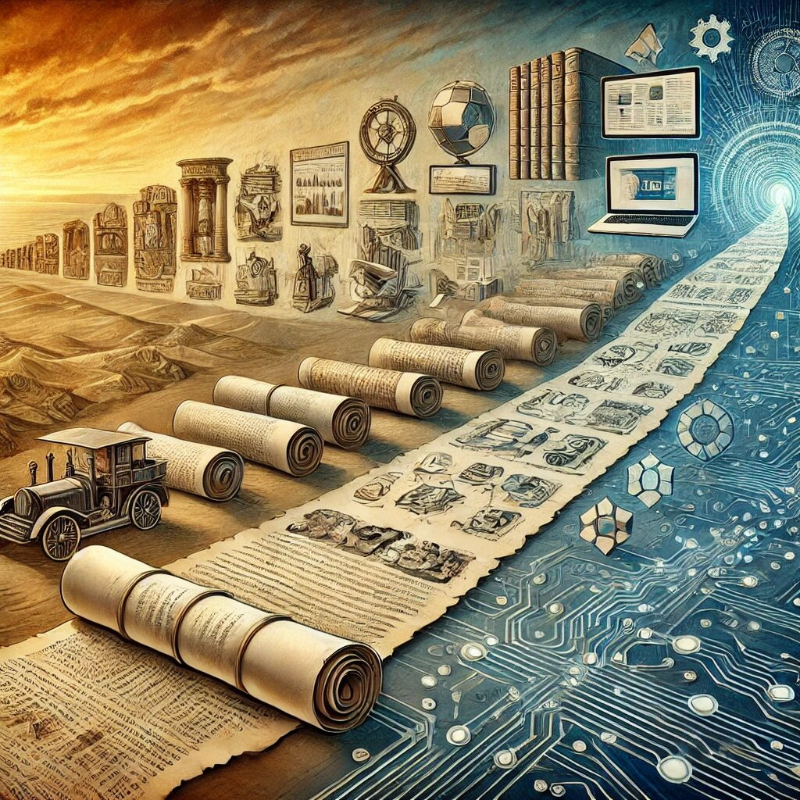
Scientific publishing is on the cusp of significant transformation, driven by historical trends and emerging technologies. By looking back at the evolution of scientific communication and image integrity, we can imagine new possibilities for the future. This article explores unconventional predictions that could redefine how we think about publishing and research integrity in the coming decades.
The Evolution of Scientific Publishing and Image Integrity
Over the years, the shift from exclusive, subscription-based journals to open-access platforms has democratized access to scientific knowledge, making it available to a global audience. This trend has fostered greater collaboration but also increased the volume of published research, leading to challenges in quality control.
Prediction: In the future, we might witness the emergence of decentralized research networks. In this model, researchers could publish their findings directly to blockchain-based platforms. These platforms would facilitate peer-to-peer review, data sharing, and collaboration without the need for traditional journals. Each piece of research could be timestamped and verified on the blockchain, ensuring that both the data and the images associated with it are authentic and unaltered. This shift could decentralize control over scientific communication, giving researchers more autonomy and making the publishing process more transparent and secure.
The Role of Visual Data in Science
The use of images in scientific research has evolved dramatically, from static illustrations to complex visualizations, including 3D models and video data. As visual data becomes increasingly important, so too does the need to ensure its integrity.
Prediction: In the future, we may see scientific papers published not just as text and images, but as fully immersive virtual reality (VR) experiences. Imagine navigating through a 3D environment where you can explore data in a spatial context, walk through molecular structures, or witness real-time simulations of experiments. This approach would offer a more intuitive understanding of complex scientific concepts. However, ensuring the integrity of such immersive environments would require new tools and standards, particularly to prevent the distortion or manipulation of visual data in these virtual spaces.
Ensuring Data and Image Integrity
As datasets have grown larger and more complex, the integration of AI into research has increased. AI tools are now used to analyze data, identify patterns, and even generate hypotheses. However, this also introduces risks, such as bias in AI algorithms or the potential for AI-generated images and data to be manipulated.
Prediction: To address these challenges, we might see the establishment of AI-Governed Research Ethics Councils in the future. These councils would leverage advanced AI to monitor the integrity of data and images in real-time across the research lifecycle. They could flag potential ethical issues, such as data fabrication or image manipulation, and even suggest corrective actions. Acting as independent, automated watchdogs, these AI councils would help maintain the integrity of research in an era where AI plays an increasingly central role.
Until such a future is realized, Proofig AI is already leading the charge in this area. Our cutting-edge technology can detect AI-generated images, identifying those created by the most widely used models, with continuous updates to recognize images from new models as they emerge. This capability allows us to safeguard the integrity of visual data in research today, providing a crucial line of defense against the risks posed by AI-driven image manipulation.
Conclusion
The future of scientific publishing and image integrity is poised to be radically different from what we know today. The convergence of new technologies and historical trends will lead to innovations that challenge our current paradigms. From decentralized research networks and VR scientific papers to AI-governed ethics councils, the next decades promise to transform how we create, share, and verify scientific knowledge.
As we look toward this exciting future, it’s essential to stay informed about the latest developments in scientific publishing and research integrity. Embrace these changes and consider how you can contribute to shaping the future of science.
Frequently asked questions
Is automated image integrity screening already part of scientific publishing today?
Yes, automated image screening is already used by leading journals, through Proofig AI, the image integrity platform trusted by the Science family of journals. The Science family adopted it across all six of its journals, MDPI signed a multi-year deal, and publishers including Springer Nature, Taylor & Francis, SAGE and AACR trust Proofig AI. Proofig AI pioneered automated pre-publication image screening and lists 250K+ Manuscripts Scanned, with results in minutes; every finding is flagged for your review.
Can journals detect AI-generated images in submissions today, or is that still a future problem?
Journals can detect AI-generated images today: Proofig AI screens six categories, from microscopy and histology to Western blots and gels. On its benchmarks it records 95.41% true positives on microscopy and 97.68% on Western blots, with false-positive rates of 0.0093% across 200K real microscopy images and 0.0020% across 250K real Western blot images. Proofig AI’s models are continuously updated as new image generators emerge, and every flagged image goes to you for review with forensic tools.
Could blockchain records prove that research images are authentic and unaltered?
Not on their own: a blockchain record shows an image file is unchanged since registration, not whether the image was sound beforehand. A duplicated panel, a spliced blot or an AI-generated micrograph can be timestamped as easily as a genuine one. Proofig AI checks the image content itself for duplication and reuse, manipulation and image plagiarism across every scientific image type, and for AI-generated images in six categories, with results in minutes; every finding is flagged for your review.
Should journals screen every submission’s references for retracted and hallucinated citations?
Yes, screening each submission’s references is worth making routine, because AI writing tools make hallucinated citations easy to produce. Retracted papers can also go on being cited for years after their retraction. RefGuard, Proofig AI’s reference integrity product, screens each manuscript for citations to retracted papers and hallucinated references. Publishers and research institutions can also run RefGuard inside PubShield, together with Proofig AI’s image integrity checks, with all results in one dashboard.