
Most image integrity issues in submitted manuscripts are unintentional, arising from figure preparation errors, mislabeled panels, or mistakes introduced by collaborators during data handling. Journal editors can integrate image integrity screening at three practical points, submission intake, desk review, or pre-acceptance, to surface these issues early. Tools like Proofig AI connect directly with editorial management systems such as Editorial Manager, helping surface potential issues for editorial review without adding manual steps. Automated screening supports human judgment; it does not replace it.
Why Has Image Integrity Screening Become a Practical Necessity?
The scale of image-related problems in submitted manuscripts has outpaced what editorial teams can manage through manual review. One image integrity expert has estimated that approximately 20 to 35% of life-science manuscripts submitted to journals may contain image integrity issues (UKRIO), and many of those issues are likely unintentional, arising from figure preparation errors, mislabeled panels, or mistakes introduced by collaborators during data handling.
These issues surface at the submission stage, well before peer review and publication, which is exactly where editorial screening can catch them. Many of the flagged figures reflect honest error rather than deliberate manipulation, so the practical goal is to surface suspected problems for human review rather than to assign intent.
Peer reviewers are not the solution here. Reviewers evaluate scientific merit, experimental design, and interpretation. They are not trained in forensic image analysis, and they are not expected to be. A peer-reviewed study at the University of Split found that researchers correctly identified only 32.4% of image duplications when tested, and medical students identified just 29.4%. Even trained eyes miss the majority of problems.
At the same time, submission volumes continue to rise. Manual figure inspection for every manuscript is not realistic for most editorial offices. This is a structural problem, not a reflection of researcher ethics, and it requires a structural solution.
Where in the Editorial Workflow Does Image Screening Fit?
There are three natural insertion points for automated image integrity screening. Each has trade-offs, and the right choice depends on your journal’s volume, resources, and risk tolerance.
| Workflow Stage | How It Works | Best For |
|---|---|---|
| At submission | Automated screening runs when the manuscript enters the system, before it reaches an editor’s desk. Issues are flagged before any editorial time is invested. | High-volume journals that need to filter problems early |
| At desk review | The editor reviews a screening report alongside the manuscript before deciding whether to send it to peer review. Editorial judgment is preserved with an added layer of structured evidence. | Journals that want editor-controlled decision-making at every step |
| At acceptance | A final screen before production catches anything introduced or altered during revision. | Journals concerned about changes made between initial submission and final version |
Many journals will benefit from screening at more than one stage. A submission-stage screen catches the bulk of issues early, while a pre-acceptance screen serves as a final check.
The key point is that editors do not need to choose a single approach. These stages are complementary, and image integrity quality assurance can be configured to match your journal’s existing process.
What Does Automated Image Screening Actually Detect?
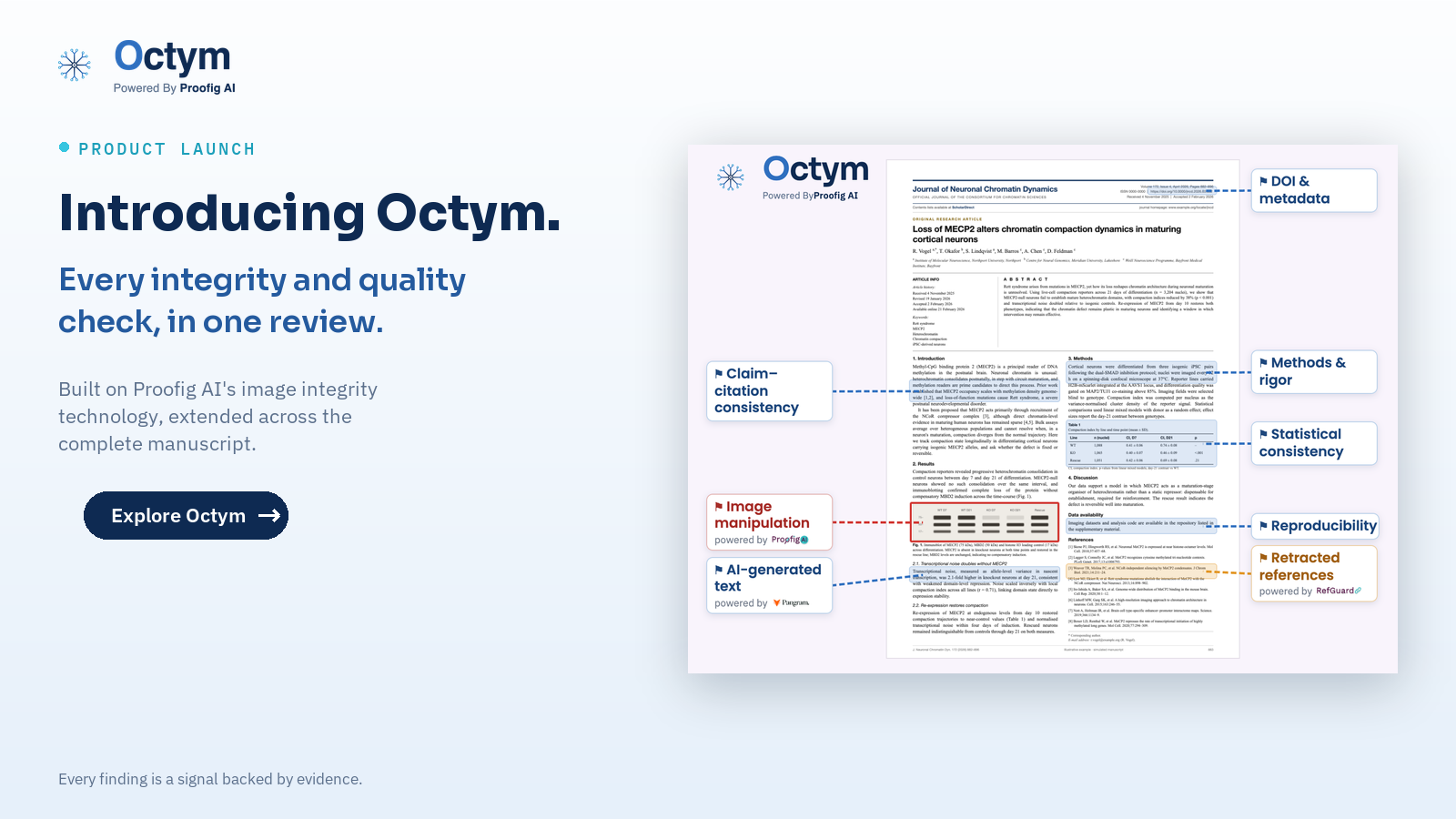
Automated image integrity tools analyze the figures in a manuscript and flag suspected issues for editorial review. Proofig AI, for example, detects:
- Duplication and reuse within a single manuscript, including scaled, rotated, flipped, or partially overlapping regions
- Image manipulation, including cloning, splicing, deletion, and content-aware edits within a single figure
- AI-generated images across microscopy, histology, Western blots, gels, cell plates, and medical scans
- Image plagiarism against PubMed’s database of tens of millions of published images
- Self-plagiarism, through comparison with a researcher’s own previously published work via a personalized repository
The rise of AI-generated scientific figures adds urgency to this list. Nature has reported that AI image-generation tools can now produce synthetic scientific figures that are difficult to distinguish from real data, and that the threat is systemic rather than isolated.
What automated screening does not do is equally important. It does not make editorial decisions. It does not assign intent. It does not determine whether an issue reflects honest error or deliberate manipulation. The tool surfaces suspected problems. The editor decides what to do with them. This distinction matters: the goal is to support human review by surfacing suspected issues early, not to replace editorial judgment.
Proofig AI is validated on hundreds of thousands of real scientific images and is designed to minimize false alarms, so editors are reviewing genuine concerns rather than chasing phantom flags.
How Does This Integrate with Editorial Management Systems?
A common concern is that adding image screening means adding another platform, another login, and another step. This is where system integration matters. Proofig AI integrates with Editorial Manager, one of the most widely used editorial management platforms in scholarly publishing. This integration enables automated image integrity screening within the editorial workflow itself, reducing the need for editors to move between separate tools.
Leading journals, including those in the Science family, have adopted Proofig AI as part of their editorial workflows, treating automated image screening as analogous to text-similarity tools like iThenticate. MDPI, one of the largest open-access publishers, also adopted Proofig AI in a multi-year agreement. These are not experimental pilots. Automated image screening is becoming an editorial standard.
For journals that need broader manuscript quality assurance beyond image integrity, Proofig also offers PubShield, a submission hub that combines image integrity screening with partner checks for text similarity, AI-generated text detection, reference integrity, and data compliance, all in a single dashboard.
What Should Editors Look for When Evaluating an Image Integrity Tool?
If your journal is considering automated image screening, these are the practical questions to ask:
- Image type coverage: Does the tool handle the image types common in your journal’s scope, such as microscopy, Western blots, histology, FACS, medical scans, and cell plates?
- System integration: Does it connect with your editorial management system, or does it require a separate login and manual upload for every manuscript?
- Actionable reporting: Does the report give editorial staff enough context to make a decision, or just a binary flag?
- False-positive rate: Does the tool minimize false alarms so editors are not spending time on non-issues?
- Validation on real images: Is the tool validated on real scientific images across relevant modalities, not just general image datasets?
- AI-generated image detection: Given the rapid rise of AI-generated figures in research, does the tool detect synthetic images across the modalities your journal publishes?
These criteria are not abstract. They determine whether image screening becomes a useful part of your workflow or an administrative burden.
How Should Editors Get Started?
Editors at smaller journals, or those new to automated screening, do not need to overhaul their workflow at once. A reasonable starting point is running image integrity screening at the desk-review stage for a defined manuscript category, such as original research articles in image-heavy disciplines. This lets editorial staff build familiarity with the report format, calibrate how they interpret flagged items, and assess the value before expanding to other stages or manuscript types.
The goal is straightforward: make image integrity review a routine part of editorial quality assurance, not an exceptional response to a suspected problem. Retraction rates have been rising steadily, underscoring the importance of catching issues before publication. Doing so protects the journal’s record, its reviewers’ time, and the researchers whose work depends on a trustworthy literature.
Starting small is fine. Starting is what matters.